

Happy Friday!
We finally moved! This is the first AI in Lab Coat post on Substack.
I brought the whole archive along too, including some of my early posts, lots of sentimental value there. I know it’s come a long way, both in content and structure. Couldn’t quite bring myself to leave those behind.
So if things look a little different this week, that’s why. Hopefully the move went smoothly on your end.
Anyway, glad you made it over.
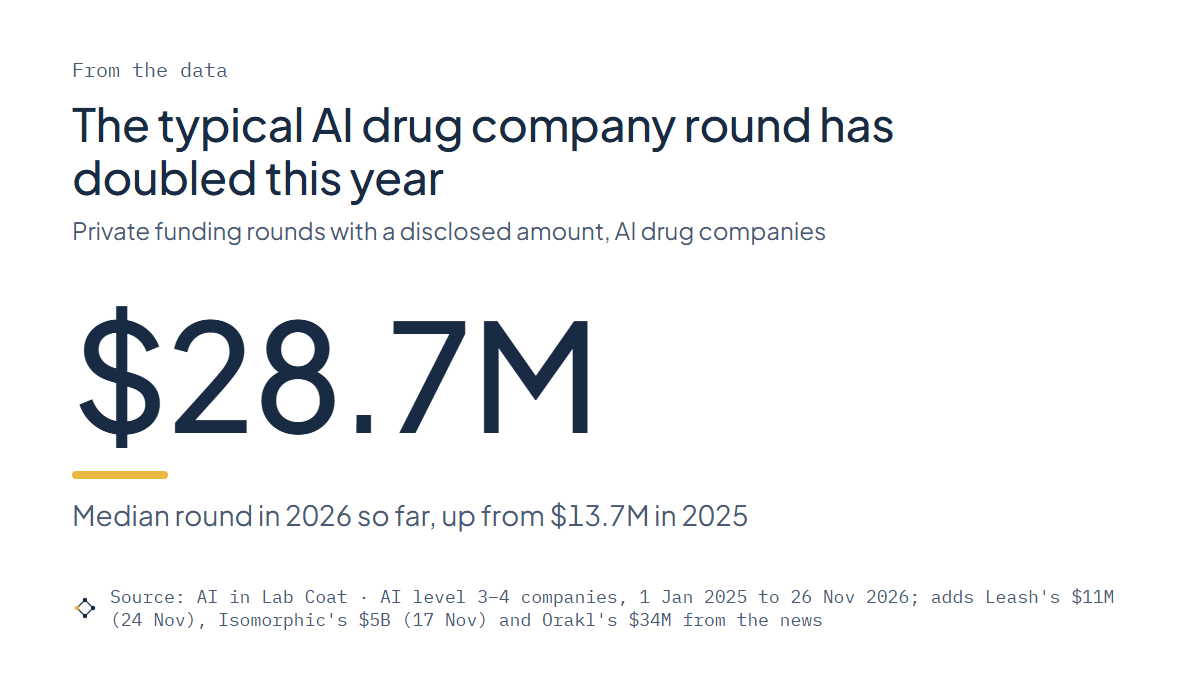
AI drug companies are raising bigger rounds year-over-year.
The median private round, has doubled from $13.7 million in 2025 to $28.7 million this year (so far). That is again, median, so the massive raise by Isomorphic’s $5 billion isn’t skewing the figure up. The difference is at the small end: rounds under $10M were about four in ten last year, and fewer than one in five this year.
Elsewhere this week
OpenAI used GPT-6.2 to help design proteins, and 35 of 322 tested showed binding to their intended targets. The model came up with the shapes, while specialist tools supplied the amino-acid sequences and helped choose which designs to test. [Link]
Merck teamed up with Isomorphic Labs to design new cancer drug candidates. They’ll focus on one target, using Isomorphic’s AI and Merck’s research data. Merck will handle subsequent development, though the target and payment amounts haven’t been disclosed. [Link]
Illumina came first among 805 final entries in Arc Institute’s Virtual Cell Challenge. Models had to predict how cells would respond when certain genes were turned down, then have their predictions checked against real experiments. FlowState and Xaira’s team took second and third. [Link]
When Drug Design Moves Faster Than Safety Knowledge

Ascletis’s new weight-loss drug has 41 amino acids, a number that is making the rounds in this week’s news cycle, and one they’re quite proud of. In announcing a US Phase 1 clinical trial this week, it explained that the drug was engineered with 41 alpha amino acids, qualifying it for regulation as a biologic which doesn’t follow the conventional drug approval pathway.
To understand why this is such big new (at least to me!), amino acids are the building blocks of proteins. Under the FDA’s definition, a molecule with a defined sequence of more than 40 amino acids counts as a protein. This puts it right under the biologics framework, which has their own set of rules governing competition. Eligible biologics also get four additional years before Medicare can select them for price negotiation, when compared to other eligible drugs.
So the decision on how a drug is designed can affect how long a company enjoys certain commercial protections. Ascletis, which says it used AI-assisted discovery, is quite open about recognizing that benefit.
This puts us in a very strange grey area of drug design. What is the impact of adding another amino acid to the sequence? Most likely (safety-wise)very little, but now they inherit a completely new set of advantages. Regardless, they will still need to demonstrate that this little addition can still result in a safer and effective drug. Still, the FDA chose this numerical boundary partly because a clear definition makes regulation more predictable. But I think it also gives us a glimpse of something that could become much harder to manage in the future.
As AI creeps evermore into our lives, it also gives scientists more possible ways to design drugs faster, pushing out countless potential candidates. But now, future biotech and pharma companies could also find candidates that not onluy works, but could identify one fits a financially attractive category or easier regulatory pathway. We don’t know whether Ascletis’s AI was used that way, but the incentive is easy enough to see.
Where does this lead next? Well, imagine these drug designs gradually behaving in ways that are unusual in the medicines that we know, but on paper, they are still grouped in that same regulatory category. Our safety expectations are partly based on what have learned from those older drugs, so eventually, I think we would have to reconsider how much of that experience applies to the molecules we’re designing and making now.
There is already a scientific reason to take this possible future seriously. Large antibody drugs generally cannot enter cells, which makes them unlikely to directly interfere with certain ion channels involved with the heart’s electrical rhythm. That helps explain why some cardiac tests are generally unnecessary for antibody therapeutics unless there are evidences that raises that concern.
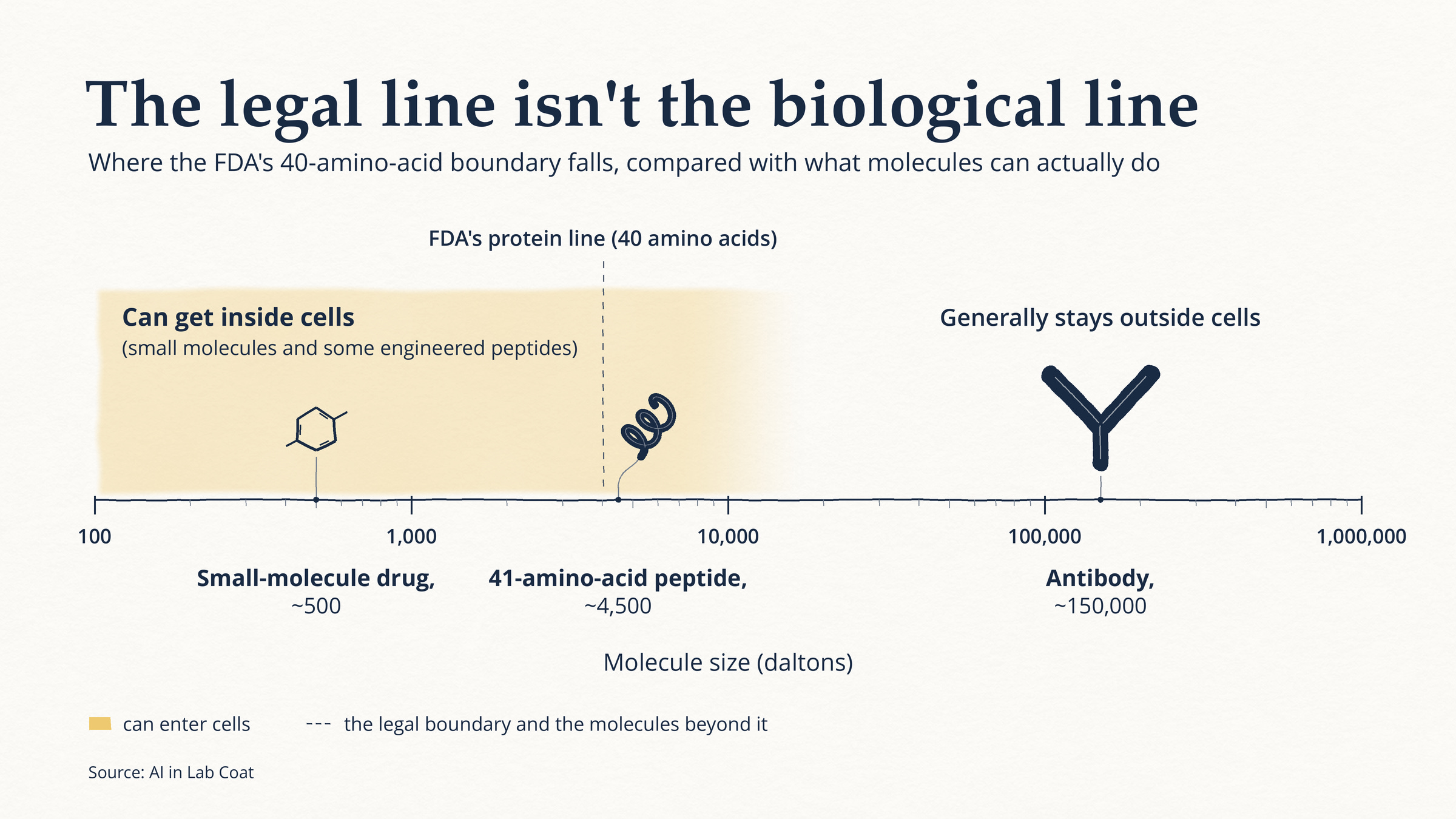
Researchers are already developing smaller, engineered peptides that can enter cells. FDA scientists have specifically flagged this sort of uncertainty about whether a cell-penetrating peptide containing unusual amino acids could carry that cardiac risk. A property that makes a molecule more useful could also inadvertently make previous safety experience less reassuring.
This is where I start to feel a bit uneasy about the pace of drug development with AI. If generating alternative drug designs becomes so much faster, any company could explore the edges of existing regulatory categories and the rules that govern them even before we have enough experience to understand all of its possible implications.
Changing a rule would change what developers search for next, while the experiments needed to assess the actual therapeutic response, including safety, would still take time, a lot of time… In fact, sometimes an adverse affect may not show up until years later.
Clinical trials are still critical, of course, but what we test for depends on what we already know could go wrong. I can see a future where AI become so good at producing drug candidates that meet all the written regulatory rules, while we are still working out whether those rules take into account all the ways this new drug could behave.
There is, however, a more hopeful possibility too! As we study these new drugs, we will get a much better idea of what could go wrong, and what is it that we actually need to test for. This could make companies more willing to take risks and try things they weren’t quite sure how to develop before. Which in turn, allows us to learn more about the complete biology of drug interactions.
For now, we’re going to let that 41 amino acid drug slide. But, this is the first time for me a case of how closely molecular design and legal definitions can meet. As we get better at understanding to those definitions, I think we will need to be a little more careful on how much we assume, just because it fits a drug category we already know.
That’s it for this week!
If something caught your attention, or you think I’ve got something spectacularly wrong, hit reply. I actually read them.
See you next Friday!
— Bauris